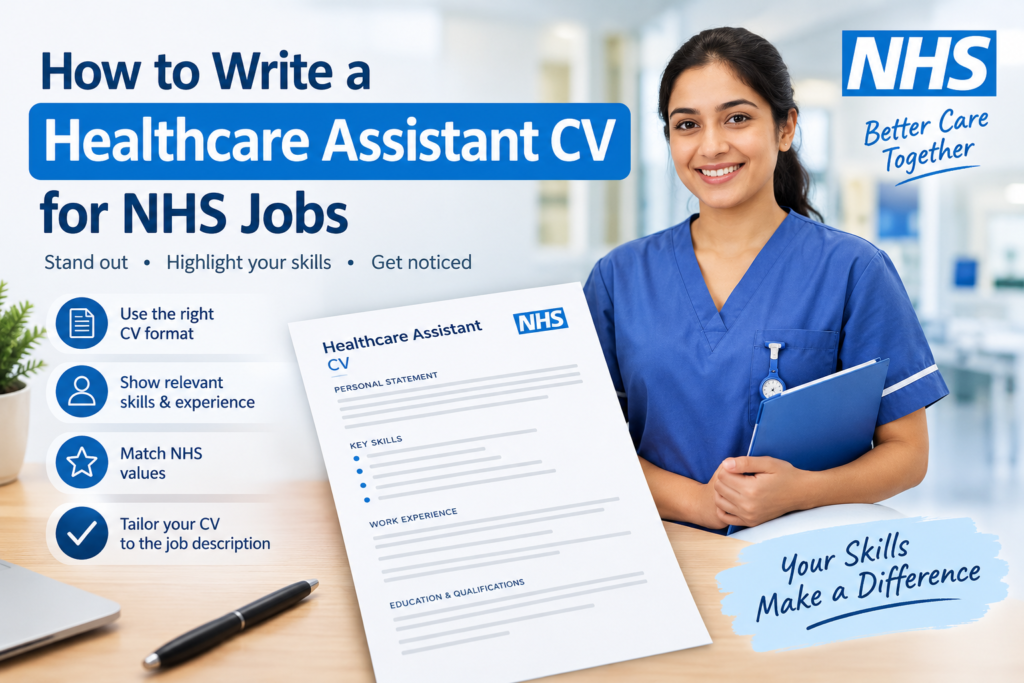
A healthcare assistant CV for an NHS job should show more than a list of caring qualities: it should give clear, honest evidence of how you support people, communicate and act responsibly. If you have not worked in a hospital before, relevant experience can still come from residential care, home care, volunteering and other people-facing roles. The key is to explain what you actually did, rather than relying on impressive-sounding phrases.
There is one important detail to know first: many NHS employers ask candidates to complete an application form, not simply upload a CV. NHS Jobs advises applicants to read the person specification, tailor each application to the post and give clear examples in the supporting information section. Your CV is still useful as a record of your experience—and some vacancies may ask for one—but follow the instructions for the particular vacancy.
Start with the job—not a generic template
Healthcare assistant duties depend on the employer and setting. In a hospital, the work may include helping patients wash and dress, supporting them with meals and mobility, making them comfortable, or taking basic observations when trained and asked to do so. In a GP surgery or health centre, the work may involve health checks, preparing rooms, restocking supplies or processing samples. The exact role is defined by the vacancy, local procedures and your training.
Read the job description and person specification before editing your CV. Mark the essential criteria and identify evidence from your own experience for each one. Requirements may mention communication, teamwork, organisation, following procedures, dignity or a caring approach. These are not keywords to paste into a skills list: the recruiter needs to see how you have demonstrated them.
NHS Health Careers describes the range of healthcare assistant responsibilities and typical skills in its healthcare assistant role guide. Duties vary by role, so treat the vacancy—not a generic online example—as the final guide.
What to put on a healthcare assistant CV
A clean, familiar layout helps a recruiter find the relevant information quickly. Most applicants can use these sections:
- Name and contact details
- A short personal profile
- Relevant skills supported by evidence
- Employment and care experience
- Education, training and certificates
- Volunteering or other relevant experience, if applicable
Contact details
Include your name, phone number, professional email address and general location, such as your town. A full home address is usually unnecessary. Do not include sensitive personal information such as a National Insurance number on a CV; provide personal details only through the employer’s appropriate application process when requested.
Personal profile
Use a few sentences to say what experience you bring, what sort of role you want and one or two strengths relevant to the vacancy. Avoid a profile that could belong to any applicant.
For example, if accurate: “Care assistant with 18 months’ experience supporting older adults in a residential setting. Experienced in providing respectful personal care, following individual care plans and sharing relevant changes in wellbeing with senior colleagues. Applying for a healthcare assistant role where I can contribute to considerate care and continue developing my skills.”
If you are new to paid care work, do not disguise that. Lead with relevant volunteering, placements, training or transferable experience, and be precise about what you have and have not done.
Skills
Choose a short list that matches the person specification and that you can support elsewhere in the CV. Depending on your real background, relevant skills might include:
- Communicating patiently with people who have different needs
- Supporting personal care while respecting privacy and dignity
- Working reliably with colleagues and sharing relevant information
- Following instructions, care plans and workplace procedures
- Staying organised when several tasks need attention
- Keeping information confidential and raising concerns appropriately
Do not claim a clinical skill because it appears in the advert. If you have observed a task, assisted under supervision or completed formal training, describe that accurately. Those are different levels of experience.
Employment and relevant experience
For each role, show the job title, employer, location and dates. Use a few concise bullets to explain relevant responsibilities and examples. A duty list is a start, but it often leaves the reader wondering how you approached the work.
Basic: “Helped residents with personal care and meals.”
More informative, if accurate: “Supported residents with washing, dressing and mealtimes in line with their individual preferences, maintaining privacy and encouraging them to do what they could independently.”
The stronger version tells the reader what the support involved and how it was delivered. It does not need invented results or inflated language. Another example, if true: “Shared relevant observations with senior colleagues and raised concerns promptly when a resident’s needs or usual presentation changed.” If you did not take part in formal handovers or clinical observations, describe your actual communication responsibilities instead.
How to turn experience into evidence
A useful example explains what was happening, what you did and why it mattered. When choosing an example, ask yourself: What did the person need? What was my responsibility? What action did I take? How did I communicate or work with others? What happened next, or what did I learn?
Imagine you supported an older person who was anxious about accepting help with a meal. If this is a real experience, you might explain that you listened, offered appropriate choices, gave the person time and followed the care plan or asked a senior colleague for guidance. The point is to show your approach—not to imply that you made a clinical decision or solved a medical issue.
Keep CV examples compact. In an application form’s supporting information section, you may have space to explain the same example in more detail and connect it to a specific criterion. NHS Jobs recommends adapting each application to the person specification and using examples to demonstrate relevant skills and experience.
Read the official NHS Jobs advice on making successful applications before completing the form; it explains why tailoring and completing the required sections matter.
What if you have no healthcare experience?
You may still be eligible for some healthcare assistant roles without hospital experience, but check the vacancy’s essential criteria carefully. NHS Health Careers notes that there are no set entry requirements for becoming a healthcare assistant, although employers may expect relevant experience, qualifications or basic literacy and numeracy depending on the post. Do not assume every vacancy has the same requirements.
Look for honest, relevant evidence in places such as:
- Volunteering with older people, disabled people or community groups
- Home-care or residential-care placements
- Customer-facing work involving patient listening and respectful communication
- Supporting people in a school, community or activity setting
- Relevant training or certificates
- Personal caring responsibilities, described carefully and without exposing another person’s private information
Make the connection clear. A customer-service role may have helped you listen, explain information calmly and seek support when a situation was beyond your responsibility. Those skills may transfer to care work, but they are not the same as clinical experience. State the difference rather than blurring it.
If you have a work-history gap, do not invent a role to cover it. Give a brief, factual explanation when the application asks for one. NHS Jobs lists explaining employment gaps, where relevant, among the information applicants may provide in supporting information.
Tailor your CV and supporting information
A simple evidence checklist can prevent a generic application. For every essential criterion, note one genuine example or qualification. If a vacancy asks for communication skills, for instance, describe a situation where you listened, explained something clearly or adapted your approach. If it asks for teamwork, explain how you coordinated with colleagues or passed on relevant information.
Use the employer’s terminology when it accurately describes your experience, but do not copy the advert word for word. If you cannot evidence a criterion, do not pretend. You may have related experience, or you may be able to explain your willingness to complete training, but follow the employer’s stated requirements.
A hospital ward post may call for different examples from a community or GP-based post. Keep your dates and facts consistent, but adjust the profile and most relevant evidence for each vacancy. Also check whether the employer asks for a CV, an application form or both; a tailored CV does not replace answering the questions on the form.
Common mistakes to avoid
Sending the same application every time
A generic CV can hide relevant strengths. Re-order or refine your examples so the closest evidence is easy to see for this particular job.
Listing traits with no proof
“Caring, compassionate and hardworking” is not evidence by itself. Add a short example of how you treated someone, responded to a need or acted responsibly.
Overstating clinical skills
Never claim to have taken observations, administered treatment or performed another clinical task unless your experience and training support that statement. Accurate boundaries help the employer understand what training you may need.
Making the document hard to scan
Use clear headings, readable text, consistent dates and short bullet points. Avoid dense blocks of text and decorative layouts that obscure the information.
Ignoring the application instructions
Complete all required sections and follow the vacancy’s directions. Some employers use the application form for shortlisting, so a polished CV alone may not be enough.
Final checks before you apply
- Your experience, qualifications and dates are accurate.
- Your profile reflects the vacancy you are applying for.
- Your examples connect to the person specification.
- You have not claimed training or clinical responsibilities you do not have.
- Spelling, grammar and contact details are correct.
- You followed the advert’s instructions about the CV and application form.
- You have removed confidential information about people you supported.
A strong healthcare assistant CV is not a collection of impressive phrases. It gives the employer a truthful picture of how you have supported people, worked with others and acted responsibly. Start with what you have genuinely done, choose evidence relevant to the vacancy and explain it plainly.
If you would like professional help presenting your experience, explore CVProWrite’s NHS and healthcare CV writing service. You can also read about the broader CV writing services offered by CVProWrite.
Leave a Reply